

"China 2025 | Economic and Political Scenarios - Operational and Sectoral Elements for Italian Companies in China"., the second part of the 16th edition of the Italy China Council Foundation-ICCF China Report, was presented today at Palazzo Clerici, Milan.
At the official event participated Giulio Bolaffi, Chief Counsellor of the Economic and Commercial Office of the Italian Embassy in Beijing, Geng Xiewei, Economic and Commercial Counsellor of the Consulate General of the People's Republic of China in Milan, Mario Boselli, the ICCF President, and numerous members, entrepreneurs and professionals representing companies that are part of the Italy China Council Foundation network.
Also speaking during the presentation were Riccardo Fuochi of Logwin Air+Ocean, Alice Arduini of Alix International, Edoardo Raffiotta of LCA Law Firm and Andrea Gianni of ALG Energy who, in addition to taking part in the drafting of the Report, animated the debate by bringing testimony from their sectors.
The China Report, enriched by the contribution of ICCF members and, from this year, authoritative academics and journalists from both countries, represents one of the most comprehensive outlooks on China currently available in Italy. Written in Italian and rich in original data and studies, the guide is a useful tool for all those small, medium and large enterprises that want to bring their business to China.
"The international context remains marked by uncertainty and unpredictability but, at the same time, we are witnessing significant transformations that deserve to be understood and analysed', ha detto Mario Boselli,, ICCF President, in his introductory speech. "The China Report prepared by our Study Centre was created precisely with this in mind: offer institutions and companies an up-to-date reading of the main changes taking place in China and stimulate reflection on the evolution of our bilateral relations'.
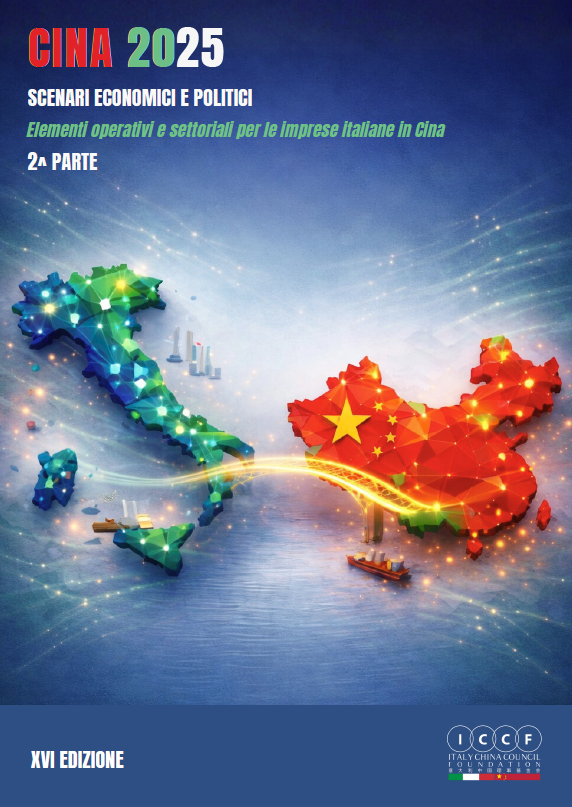
IN SUMMARY. CHINA 2025 Part 2 offers a up-to-date overview of the latest developments in Chinaboth economically and politically, in order to grasp the main changes taking place and identify the possible synergies with our country. It is divided into three chapters, with a domestic economic-political framework, an international economic-political framework, and a third in-depth section that aims to provide an operational guide for Italian companies and to delve into the opportunities of both the health-pharmaceutical sector and the energy transition.
THE DOMESTIC CONTEXT. The first chapter analyses China's domestic economic and political environment, with particular reference to the most recent developments. In 2025, the gross domestic product recorded real growth of 5% on an annual basis. From the point of view of production structure, expansion continues to be sustained mainly by the tertiary sector, confirming the role of services as one of the main drivers of economic growth. At the same time, there are signs of a gradual narrowing of the per capita disposable income gap between urban and rural areas, suggesting a slow process of territorial rebalancing. Also on the domestic consumption front a gradual, albeit still moderate, improvement can be observed. On the political level, the close of 2025 was characterised by the definition of the recommendations that will feed into the approval of the 15th Five-Year Plan scheduled for March 2026. Other highlights of the year include the large military parade of the 3 Septemberas well as the Fourth Plenary Session of the 20th Central Committee of the Communist Party of China. The chapter concludes with an in-depth look at the main reforms and development trajectories in strategic sectorsin particular artificial intelligence and policies to combat climate changeas central pillars of China's new growth model and international projection.
THE INTERNATIONAL CONTEXT. The second chapter examines China's economic dynamics in the international context, placing them within the major geopolitical developments of 2025. In 2025the Chinese trade surplus reached US$ 1.189 billion, registering an increase of about 20% compared to 2024. This result confirms China's persistent ability to export on a large scale and the continued strengthening of its industrial apparatus in global markets. The chapter then analyses trade between China and the rest of the worldhighlighting the country's central role in the international trade system. ASEAN is confirmed as China's number one trading partner, followed by European Union e United States. Within this framework, Italy maintains the position of China's 24th largest trading partner globally e of 4th at European level. The main sectors of Italy-China trade are also analysed, with particular attention to import and export dynamics. Alongside the economic analysis, the chapter devotes ample space to the international political-strategic context. In the second part of 2025, China promoted a new initiative of global scope, the Global Governance Initiative. In addition, the Sino-US relations have gone through a phase of relaxation of a tactical nature; however, on the strategic planthe new US National Security Strategy continues to frame China as the main actor in a systemic competition. The chapter also analyses the evolution of relations between China and Japan in the Takaichi Eraand the process of realignment of relations with India. It then goes into detail the role of the Shanghai Cooperation Organisation and the last summit in China in September 2025, highlighting its regional and global implications. Regarding relations between China and the European Unionthe picture remains characterised by a regular political dialogueeven in the face of limited concrete results. Finally, on the bilateral level, particular emphasis is placed on relations between Italy and China, with a focus on the 12th session of the Intergovernmental Committeewhich was held in Rome last October.
ENTRY MODES AND SECTOR PERSPECTIVES IN THE CHINESE MARKET. The third chapter offers a operational guide for Italian companies interested in accessing the Chinese consumer goods market. The main entry modes are analysed, comparing traditional trade and Cross-Border E-Commerce (CBEC), as well as the role of the Chinese customs administration in the market access process. A further section is devoted to the opportunities in the health and pharmaceutical sectorThis is a rapidly expanding field with significant potential for collaboration and complementarity between China and Italy. The paper concludes with an in-depth look at the energy transition sectorwith a focus on photovoltaic energy, highlighting future prospects for Italy and the strategic value of cooperation with China in this field.
In the coming days, all Members will receive the full version of the Report.
For further information: centrostudi@italychina.org


